The History of Pallanguzhi
Long before screens, Tamil homes had a game of many pits. Pallanguzhi has been passed down from grandmothers to grandchildren for generations, and its story is tied up with festivals, kitchens, courtyards and counting.
Part of the world’s oldest game family
Pallanguzhi is a mancala game: a family of “sowing” games played across Africa, the Middle East, South and Southeast Asia. Mancala games are among the oldest board games still played. Carved boards with rows of pits have been found at historic sites in East Africa and the Middle East, and the games travelled along trade routes across the Indian Ocean.
In South India the game settled into a distinctive local form: two rows of seven pits, relay sowing, and the unusual pasu rule, where any pit reaching four seeds is claimed by the owner of its row.
A game of homes and courtyards
In Tamil Nadu, Pallanguzhi was traditionally a household game, played on verandahs (thinnai), in courtyards and on kitchen floors. It is especially associated with women and girls, and many people today remember learning it from a grandmother or aunt during long summer afternoons, festival holidays like Pongal, or family gatherings.
Because it needs nothing more than a board and a few dozen seeds, it travelled easily. Families without a board simply scooped fourteen small pits into the ground.
Boards: from carved wood to brass
Pallanguzhi boards range from plain wooden planks to heirloom pieces. Wooden boards from regions such as Chettinad are often richly carved, and some fold in half on a brass hinge to store the seeds inside. Boards may be shaped like fish or decorated with brass fittings. A finely made board was a valued household object and sometimes part of a bride’s trousseau.

Seeds: manjadi, tamarind and cowries
- Manjadi (மஞ்சாடி): the glossy red seeds of the red sandalwood tree, Adenanthera pavonina. They are famously uniform in size and were once used as a weight for measuring gold.
- Puliyankottai (புளியங்கொட்டை): tamarind seeds, collected from every kitchen.
- Sozhi (சோழி): cowrie shells, which clatter beautifully into the pits.
Learn more in our guide to the Pallanguzhi board and seeds.
Why elders loved it: counting, memory and patience
Pallanguzhi is a quiet mental workout. Players count seeds constantly, predict where a chain of sowing will end, and remember how the board looked a few moves ago. Elders often describe it as a way to sharpen arithmetic and concentration in children, and it builds fine motor control from handling small seeds.
The game also teaches a very Tamil kind of patience: porumai. The player who rushes usually hands the other a pasu.
The same game, many names
Neighbouring regions play close cousins of Pallanguzhi under different names: Ali Guli Mane in Karnataka, Vamana Guntalu in Andhra Pradesh and Telangana, Kuzhipara in Kerala and Chenne Mane in Tulu Nadu. See every name and spelling for Pallanguzhi.
Pallanguzhi today
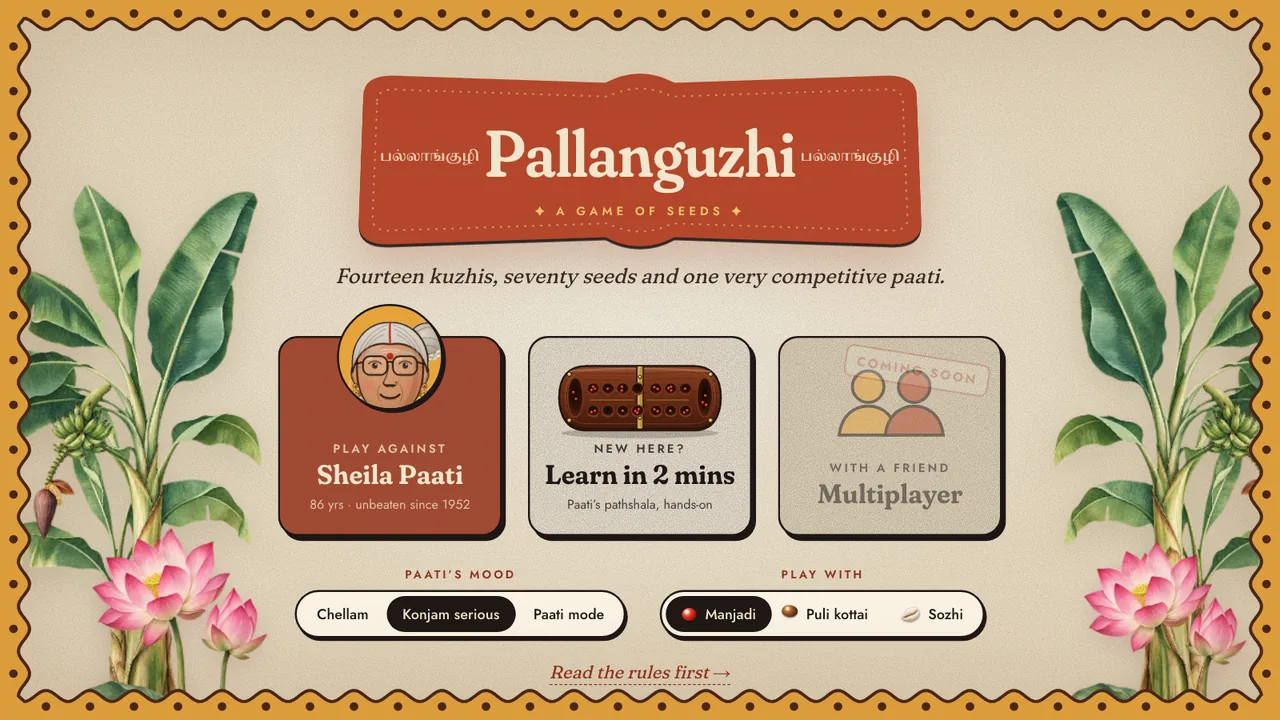
Like many traditional games, Pallanguzhi faded as families moved to apartments and phones. It is now enjoying a revival: craft stores sell new boards, schools use it to teach counting, and families bring it out during Pongal and summer holidays. This site is part of that revival. It’s a free, browser-based Pallanguzhi you can play in a minute, with a grandmother who teaches you as you go.